American White Armorie Authenticated Reproduction From the Museum of American Folk Art
 | |
 American Folk Fine art Museum | |
 | |
| Established | June 23, 1961 (1961-06-23) |
|---|---|
| Location | 2 Lincoln Foursquare Manhattan, New York, U.s. |
| Coordinates | xl°45′42″N 73°58′41″W / 40.7616°N 73.9781°W / 40.7616; -73.9781 Coordinates: xl°45′42″N 73°58′41″W / twoscore.7616°N 73.9781°West / 40.7616; -73.9781 |
| Manager | Jason T. Busch |
| Public transit admission | Subway:  to 66th Street–Lincoln Center to 66th Street–Lincoln CenterBuses: M5, M7, M11, M20, M66, M104 |
| Website | www |
The American Folk Fine art Museum is an fine art museum in the Upper Westward Side of Manhattan, at 2, Lincoln Square, Columbus Artery at 66th Street. It is the premier institution devoted to the aesthetic appreciation of folk art and creative expressions of contemporary cocky-taught artists from the U.s.a. and abroad.
Its collection holds over 8,000 objects from the 18th century to the present. These works span both traditional folk art and the piece of work of gimmicky self-taught artists and Fine art Brut. In its ongoing exhibitions, educational programming, and outreach, the museum showcases the artistic expressions of individuals whose talents developed without formal artistic preparation.
Admission is free. The museum had record yearly attendance of more 130,000 visitors.[ane] [2]
History [edit]
Since receiving a provisional charter in 1961, the American Folk Art Museum has continually expanded its mission and purview. At its inception, the museum lacked a permanent collection, an endowment, and a building. Despite lacking these institutional fixtures, founding Trustees Joseph B. Martinson and Adele Hostage had a vision: the advancement of the understanding and appreciation of American folk arts. In the museum's almost threescore-yr history, this dedication has held true. The museum's evolving mission reflects the shifting understanding of folk art internationally.[iii]
The Museum of Early American Folk Arts, equally information technology was known initially, held its first exhibition in a rented space on 49 W 53rd Street in 1961. The museum's collection was launched in 1962 with the gift of a gate in the form of an American flag, celebrating the nation'south centennial.[4] The gift reflected the museum'southward early on focus on eighteenth and nineteenth-century vernacular arts from the northeast America.
In 1966, after receiving a permanent charter, the museum expanded its name and mission. As the Museum of American Folk Arts, it looked beyond the traditional definitions of American folk art. Its exhibitions and collection began to reverberate "every aspect of the folk arts in America – north, southward, due east, and west."[5] Founding curator Herbert Due west. Hemphill Jr. "expanded the notion of folk fine art beyond traditional, utilitarian, and communal expressions."[6] Nether his direction, the museum began to champion idiosyncratic and individualistic artwork from the fields of traditional and contemporary folk fine art. In doing so, the museum ushered in a new era in the field of twentieth-century folk art. The 1990s brought new focus to the diversity and multiculturalism of American folk art. Offer a more than inclusive vision, the museum began to present African American and Latino artworks in their exhibitions and permanent collections. Director Gerard C. Wertkin announced American folk fine art'south common heritage every bit "promoting an appreciation of diversity in a way that does not foster ethnic chauvinism or racial division."[7]
The museum farther established its broadened outlook with the 1998 formation of the Gimmicky Center, a segmentation of the museum devoted to the work of 20th and 21st century self-taught artists, as well as non-American artworks in the tradition of European art brut. In 2001, the museum opened the Henry Darger Study Center to firm 24 of the self-taught creative person's works, besides as a drove of his books, tracings, drawings, and source materials.
In 2001, the museum chose its electric current proper noun, American Folk Art Museum. Recognizing that American folk fine art could but be fully understood in an international context, the word American functions as an indication of the museum'south location, accent, and chief patronage rather than as a limitation on the kind of fine art information technology collects, interprets, or presents. The museum's current programming reflects this shift in focus. By exhibits have included folk arts of Latin America, England, Kingdom of norway, among other countries and continents.
As the museum'south mission developed, so did its attempt to found a permanent home. In 1979, the Museum'due south Lath of Trustees purchased ii townhouses on West 53rd Street, next to Museum'south rented quarters at 49 West 53rd Street. In 1984, while waiting to develop the West 53rd properties, the museum continued to organize exhibitions and educational programs from a former carriage house at 125 Westward 55th Street. Five years after, a new branch of the museum, the Eva and Morris Feld Gallery, opened at 2 Lincoln Foursquare, New York, opposite Lincoln Eye for the Performing Arts.
In 2001, a new building on 45–47 West 53rd Street was opened. Tod Williams and Billie Tsien designed an eight-level building on a forty-pes-broad, one hundred-foot-long site on 53rd Street.[8] From 2001 to 2011, the midtown space served as the museum's main branch. However, facing increasingly high bail payments, the museum sold the midtown co-operative to the Museum of Mod Art.[9] When MoMA announced that it was going to demolish the building in connectedness with its expansion, in that location was outcry and considerable discussion about the upshot, but the museum ultimately proceeded with its original plans.[10] [11]
Following the sale, the American Folk Art Museum used its facility at 2 Lincoln Foursquare every bit its main exhibition and shop space. In 2014, the museum's athenaeum, library, and administrative staff moved to Long Island Urban center, Queens. In September 2017, the museum opened the Self-Taught Genius Gallery at its facility in Long Isle Urban center. The STG gallery shows fine art from the museum'southward collection in thematic exhibitions that change every few months. The STG Gallery is funded in large part past the Henry Luce Foundation.
The drove [edit]
Continuing every bit "one of New York City'south great treasures",[12] the museum's 7,000 plus collection has been formed nearly entirely through gifts. Spanning a wide variety of mediums, the collection includes over ane,200 paintings on sail or panel, 1,500 drawings and works on paper, 1,000 sculptural objects, i,000 fabric items, 200 ceramic objects, 100 pieces of furniture, 300 decorated household items from the Historical Social club of Early on American Decoration, and two large-scale architectural models.
Additionally, the museum has a large collection of archives, artist files, films, recordings, photographs, original research, historical records, and other contrasted and valuable ephemera. Virtually notably, the museum holds the largest collection of archival materials from cocky-taught artist Henry Darger.
The collection ranges from early portraits by Sheldon Peck, Ammi Phillips, Asa Ames, and Samuel Addison Shute and Ruth Whittier Shute, quilts and schoolgirl needlework, article of furniture, and weathervanes to works by acclaimed masters such equally Thornton Dial, Morris Hirshfield, Martín Ramírez, Judith Scott, Mary T. Smith and Bill Traylor.
The museum continues to add to its growing collection. In recent years acquisitions have included a version of Edward Hicks's (1780–1849) famed The Peaceable Kingdom. Notably, this painting, which Hicks gave to his daughter, remained with Hicks's descendants for many years. The portraits Increment Child Bosworth and Abigail Munro Bosworth by Sheldon Peck (1797–1868), Pickman's Mephitic Models by Paul Laffoley (1935–2016), Plantation Life by Clemmentine Hunter (1886/87–1988), and Heavenly Children by William Matthew Prior (1806–1873). Street creative person KAWS donated a rare sculpture by cocky-taught artist William Edmondson to the museum in 2021.[xiii]
Selected collection highlights [edit]
-

Artist unidentified, Flag Gate, 1876
-

Artist unidentified, Bird of Paradise Quilt Summit, 1858–1863
-

Creative person unidentified, Hudsonian Curlew Weathervane, 1874
-

-
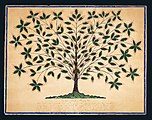
Hannah Cohoon, Gift Drawing: The Tree of Light or Blazing Tree, 1845
Exhibitions [edit]
Each year, the museum mounts a number of exhibitions, which span from the traditional folk arts to the more contemporary "self-taught" expressions. The museum'due south exhibits frequently examine the works of a specific artist or the significance of a particular medium, such every bit quilts or tinsel paintings.
Through its exhibits, the museum continues to develop the agreement of folk and cocky-taught artists. Past exhibits have showcased the works of "undersung" masters, such every bit Thomas Chambers and Asa Ames.[fourteen] Additionally, the museum has hosted solo exhibitions defended to the work of self-taught greats: Martín Ramírez, Eugene Von Bruenchenhein, Willem van Genk, Ronald Lockett, John Dunkley, Paa Joe, and Bill Traylor.
Past exhibits take likewise positioned traditional folk art in conversation with more than contemporary art. In the museum's 2008 exhibit, "The Seduction of Calorie-free: Ammi Phillips/ Marker Rothko Compositions in Pink, Green, and Red" explored the visual connections betwixt Rothko'southward famed color blocks and Phillip'due south heightened color palette. In 2013, the museum invited thirteen fashion designers to create an original work, inspired by a piece in their collection. The resulting exhibit "Folk Couture: Fashion and Folk Fine art" ran from January 21 – April 23, 2014. Subsequent major exhibitions include 2016's Mystery and Benignancy: Masonic and Odd Fellows Folk Art, Securing the Shadow: Posthumous Portraiture in America, Eugen Gabritschevsky: Theater of the Imperceptible, Carlo Zinelli (1916–1974), 2017's War and Pieced: The Annette Gero Collection of Wartime Quilts, 2018'south Vestiges & Poesy: Notes From the Newfangled Ballsy, and, as well in 2018, Charting the Divine Programme: The Art of Orra White Hitchcock (1796–1863). In 2019 the museum will show Fabricated in New York Metropolis: The Business concern of Folk Art.
At the Self-Taught Genius Gallery in Long Island City, the exhibitions have included Holding Space, Handstitched Worlds: The Cartography of Quilts, and Roadside Attraction.
By raising traditional folk artists and cocky-taught artists from the periphery of the mainstream art globe, the museum has continued to bear witness "the worth of instinctive, self-taught artistry."[fourteen]
Stacy C. Hollander was the museum's chief curator and managing director of exhibitions from 1992 until stepping downwardly in 2019.[15] Since joining the museum in 2013, Dr. Valérie Rousseau has served as the curator of self-taught fine art and art brut. Emilie Gevalt joined the museum equally curator of folk art in 2019.[xvi]
Notable exhibitions [edit]
In 2014, the museum launched the exhibition, Self-Taught Genius: Treasures from the American Folk Art Museum. Featuring more than 100 works of art, "Self-Taught Genius" offered "an intellectually provocative attempt to rethink the nature of artistic inventiveness" from the eighteenth century to the present.[17] Following its New York premiere, the exhibition travelled to six cities, as function of a national tour funded by the Henry Luce Foundation'due south 75th anniversary initiative.[xviii]
Publications [edit]
In December 2013, the American Folk Art Museum launched a fully attainable digital archive of 117 issues of its in-business firm magazine, Folk Art, formerly known as The Clarion. From winter 1971 to fall 2008, Folk Art, was published on average of three times a year. Information technology served as a forum for original research and new scholarship in the field of American folk fine art. Topics ranged from traditional arts, such as portraiture, schoolgirl arts, painted article of furniture, and pottery, to original discourses on under-recognized artists.
Honors [edit]
In 2007, information technology was among over 530 New York City arts and social service institutions to receive part of a $20 one thousand thousand grant from the Carnegie Corporation, which was made possible through a donation by New York Urban center mayor Michael Bloomberg.[19]

In 2013, the Encyclopedic Palace, in the Museum'due south collection, served as the inspiration and theme for the 55th installation of the international Venice Biennale. Marino Auriti (1891–1980), a self-taught Italian American artist, created the piece of work equally an architectural model for imaginary museum that would house all worldly knowledge. Massimiliano Gioni, artistic director of the Biennale, detailed the enduring relevancy of Auriti'south piece of work. "Today, as we grapple with a constant flood of data, such attempts to structure knowledge into all-inclusive systems seem even more necessary and even more than desperate."[ citation needed ]
Gift shop [edit]
Cited as one of the "World's Best Museum Souvenir Shops," the museum's souvenir shop offers gift items, handcrafted in the folk tradition, such as jewelry, personal accessories, frames, toys, objects for the home, as well equally note cards, books, and catalogs.[20]
See likewise [edit]
- List of museums and cultural institutions in New York City
References [edit]
- ^ "News | American Folk Art Museum". Folkartmuseum.org. Retrieved 2014-06-08 .
- ^ "News | American Folk Art Museum". Folkartmuseum.org. Retrieved 2015-06-22 .
- ^ For more information about the history of the American Folk Fine art Museum, see Gerard C. Wertkin, "Foreword," in Stacy C. Hollander and Brooke Davis Anderson, American Anthem: Masterworks from the American Folk Fine art Museum (New York: American Folk Fine art Museum in clan with Harry Northward. Abrams, Inc., 2001), pp. 10–13.
- ^ "FLAG GATE | American Folk Art Museum". Folkartmuseum.org. Retrieved 2014-06-08 .
- ^ Folk Art, Summer 2001, 21.
- ^ Brooke Davis Anderson, "The Contemporary Collection: Through The Lens of Language," American Anthem: Masterworks from the American Folk Art Museum (New York: -, fifteen).
- ^ Folk Art
- ^ "American Folk Art Museum".
- ^ Taylor, Kate (2011-05-10). "MoMA to Buy American Folk Art Museum Building". The New York Times.
- ^ Pogrebin, Robin (January viii, 2014). "A Thousand Redesign of MoMA Does Not Spare a Notable Neighbor". The New York Times. Archived from the original on July 9, 2014. Retrieved September 29, 2014.
- ^ Pogrebin, Robin (April 15, 2014). "Architects Mourn Onetime Folk Fine art Museum Building". The New York Times. Archived from the original on November 9, 2017.
- ^ Smith, Roberta (August two, 2012). "Everyday Treasures Gaze Out to Sea". The New York Times.
- ^ Cascone, Sarah (2021-11-02). "KAWS Donates 'Holy Grail' of Folk Art—a William Edmondson Sculpture Discovered on a St. Louis Porch—to New York Museum". Artnet News . Retrieved 2021-11-11 .
- ^ a b Roberta Smith, "As Folk Fine art Museum Teeters, a Huge Loss Looms," The New York Times, September 19, 2011
- ^ Moynihan, Colin (2019-04-03). "American Folk Art Museum Leader Is Stepping Down". The New York Times. ISSN 0362-4331. Retrieved 2021-11-11 .
- ^ "American Folk Art Museum Hires Emelie Gevalt as Curator". www.artforum.com . Retrieved 2021-eleven-11 .
- ^ Johnson, Ken (2014-05-22). "A Confederacy of Mavericks; Inspiration Made Concrete in 'Self-Taught Genius' Exhibition". The New York Times . Retrieved 2014-06-07 .
- ^ "$ane.6m donation to the American Folk Art Museum". artmediaagency.com. Roubaix, France: Fine art Media Agency. 2013-06-24. Retrieved 2014-06-07 .
- ^ Roberts, Sam (2005-07-06). "New York Times: Urban center Groups Get Bloomberg Souvenir of $20 Million". The New York Times . Retrieved 2010-04-23 .
- ^ Wylie, Erin (2013-eleven-07). "Quirky Souvenirs from Some of the Globe's Best Museum Souvenir Shops:American Folk Fine art Museum, New York Urban center, Reusable lunch handbag, $50". cntraveler.com. New York, NY: Condé Nast. Retrieved 2014-06-07 .
Further reading [edit]
- Folk Art (formerly The Clarion). Magazine published 1971–2008 past the American Folk Art Museum.
- Anderson, Brooke Davis. Darger: The Henry Darger Collection at the American Folk Art Museum. New York: American Folk Art Museum in clan with Harry Due north. Abrams, Inc., 2001.
- Anderson, Brooke Davis. Martín Ramírez. Seattle: Marquand Books in clan with American Folk Art Museum, 2007. A New York Times Notable Volume.
- Hollander, Stacy C. American Radiance: The Ralph Esmerian Souvenir to the American Folk Art Museum. New York: American Folk Art Museum in clan with Harry N. Abrams, Inc., 2001.
- Hollander, Stacy C., and Brooke Davis Anderson. American Anthem: Masterworks from the American Folk Art Museum. New York: American Folk Art Museum in association with Harry North. Abrams, Inc., 2001.
- Kelly, Andrew. Kentucky by Pattern: The Decorative Arts and American Culture: Quilts, Coverlets, and Shaker Textile Culture. Lexington: University Printing of Kentucky, 2015. ISBN 978-0-8131-5567-eight
- Warren, Elizabeth Five. Quilts: Masterworks from the American Folk Art Museum. New York: American Folk Art Museum in association with Rizzoli International Publications, Inc., 2010.
- Zimiles, Murray. Aureate Lions and Jeweled Horses: The Synagogue to the Carousel. With a foreword by Gerard C. Wertkin and an essay past Vivian B. Mann. Lebanon, N.H.: University Press of New England/Brandeis University Press in association American Folk Art Museum, 2007. Winner of the 2007 National Jewish Book Accolade, Visual Arts.
External links [edit]
- American Folk Fine art Museum official website
- Listing of recent American Folk Fine art Museum exhibitions
- List of upcoming American Folk Art Museum exhibitions
- "Chastened, Folk Art Museum Puts Downward Healthier Roots" Robin Pogrebin, The New York Times, April 2, 2013.
- "Crossing borders, ignoring boundaries,", Meghan Daily, The Mag Antiques, March/Apr 2014.
Source: https://en.wikipedia.org/wiki/American_Folk_Art_Museum
0 Response to "American White Armorie Authenticated Reproduction From the Museum of American Folk Art"
Post a Comment