The Art of Phoenix Wright Ace Attorney Dual Destinies
| Phoenix Wright: Ace Chaser – Dual Destinies | |
|---|---|
 English language cover fine art, featuring the iv principal characters (from left to correct) Phoenix Wright, Athena Cykes, Simon Blackquill, and Apollo Justice | |
| Developer(s) | Capcom |
| Publisher(s) | Capcom |
| Director(southward) |
|
| Producer(southward) | Motohide Eshiro |
| Designer(s) |
|
| Artist(s) | Takuro Fuse |
| Writer(s) |
|
| Composer(s) | Noriyuki Iwadare |
| Series | Ace Chaser |
| Engine | MT Framework Mobile |
| Platform(due south) | Nintendo 3DS, iOS, Android |
| Release | Nintendo 3DS
|
| Genre(s) | Adventure, visual novel |
| Way(s) | Unmarried-player |
Phoenix Wright: Ace Chaser – Dual Destinies [a] is a visual novel run a risk video game developed and published by Capcom. It is the 5th primary entry in the Ace Attorney serial, and was originally released for the Nintendo 3DS in 2013, with iOS and Android versions following in 2014 and 2017.
The game is set around a year subsequently the previous game, Apollo Justice: Ace Attorney, in a time where the court organisation has entered a dark era of false charges and fabricated show, acquired in part by the issue that led to Phoenix being unjustly disbarred. The player takes the roles of three defense attorneys Phoenix Wright, Apollo Justice and Athena Cykes, who defend their clients in multiple cases and try to restore confidence in the courts. The gameplay is split into investigation sections, where the actor searches for evidence and talks to witnesses, and trials, where they search for inconsistencies between witness testimonies and the show. The player can use some character-specific gameplay mechanics: Phoenix can run into "psyche-locks" over witnesses who are hiding something; Apollo can spot visual cues in witnesses that indicate lying; and Athena can discover conflicting emotions in witnesses' voices.
The development team included the producer Motohide Eshiro, the directors Takeshi Yamazaki and Yasuhiro Seto, and the composer Noriyuki Iwadare. Due to the game being made a long time after Apollo Justice, the developers wanted it to brand a large bear on, and came upwardly with the idea of the actor working to revive the trial system. As it was the first Ace Attorney game on the Nintendo 3DS, the developers made apply of 3D graphics; they focused on preserving the look of the earlier Ace Attorney games' 2nd art, and wanted to ensure that the graphics looked better than those in the simultaneously adult Professor Layton vs. Phoenix Wright: Ace Chaser. The game's localization was directed by Janet Hsu, and was incorporated into the overall development, allowing the localization team a larger degree of insight into the developers' intentions. The game was generally well received past critics, who praised the audio, visuals and character fine art, but criticized the game for sometimes not accepting logically valid input during trials. The game accomplished the estimated sales, which were loftier compared to how the franchise had performed in the past.
Gameplay [edit]
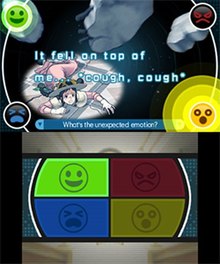
Dual Destinies introduces the "mood matrix", where the player searches for conflicting emotions in testimonies. Here, a character experiences happiness (meridian left) despite beingness in a stressful situation.
Dual Destinies is a visual novel take a chance game[1] in which the player takes the roles of 3 defense attorneys: Phoenix Wright, Apollo Justice, and Athena Cykes.[ii] The player aims to solve multiple cases and get their clients declared non guilty, which is how the game's episodes are cleared.[iii]
The gameplay is divide into two types of sections: investigations and trials. During investigations, the player goes to the criminal offense scene, where they accept access to a card with 4 options: examine, which brings upward a cursor used to search for evidence and clues; talk, which lets the player interview a witness at the current location, choosing from a number of a topics to discuss; present, which lets the player show the witness bear witness; and move, which brings upward a list of locations the player can choose to get to.[3] At some points, the player can use Apollo'southward "perceive" mechanic to watch for visual cues in a witness every bit they are talking, such as a twitching eye, that indicate that they are lying.[4] The actor can as well sometimes use Phoenix'southward "psyche-lock" mechanic to come across locks on the hearts of witnesses who are hiding something.[five]
During trials, the player cross-examines witnesses. They can motility backwards and forwards through statements in the testimony, and can choose to press the witness for more than data on a particular argument; sometimes, the witness will revise their testimony based on this. If the player spots a prevarication or a contradiction in the testimony, they tin can present evidence to demonstrate the contradiction. If the actor presents incorrect evidence, the judge'south confidence in the player will be lowered; if the judge'south confidence in the player is depleted, the game ends.[iii]
At some points, the player can utilize Athena'south "mood matrix" mechanic to notice conflicting emotions in witnesses' voices during their testimonies, such as sudden happiness in the centre of fear. Four different emotions can show upwards in testimony analyses – happiness, anger, daze, and sadness (the icon of which also represents fear) – which will light up with different intensity. The histrion goes through the testimony, and aims to determine the crusade of the conflicting emotion.[4] Near the end of trials, when the player is close to solving the case, they can utilize the "revisualization" mechanic to look back at known facts and make a serial of deductions by picking the right choices, to reach a conclusion.[six] [7]
Plot [edit]
Dual Destinies takes place roughly a year later the events of the previous game, Apollo Justice: Ace Chaser. The legal system has entered a dark era, filled with imitation charges and made evidence. Phoenix Wright, the owner of the Wright Anything Agency, retakes the bar test to one time over again get a defense attorney post-obit events in the previous game. He hires a new lawyer named Athena Cykes, who specializes in analytical psychology, to assistance his other immature attorney, Apollo Justice.
Under the watchful middle of police detective Bobby Fulbright, Phoenix, Apollo, and Athena get involved in several cases. They commencement defend mayor Damien Tenma, accused of murdering alderman Rex Kyubi. They confront Simon Blackquill in court, who prosecutes despite being on death row for murder. Despite this, Apollo and Athena expose Kyubi's real killer as Tenma'south adjutant, Florent L'Belle. Additional content set up after these events tells the story of Phoenix's first example after regaining his badge, having to defend an orca accused of killing her possessor.
Afterward, Athena defends her childhood friend, Juniper Woods, who is charged with the murder of her teacher, Constance Courte, revealing the killer equally another teacher, Aristotle Means. Sometime later, following a bombing at a space station, Apollo'south friend Clay Terran is found murdered. During the trial, where Athena and Apollo defend an astronaut named Solomon Starbuck, a flop goes off in the courtroom, injuring Apollo. Juniper is accused of the bombing, but Phoenix and Athena defend her and reveal flop squad specialist Ted Tonate every bit the real culprit. Feeling personally involved in the case, Apollo takes a leave of absence from the agency to investigate the case on his own while Phoenix takes over Solomon'southward example. He proves Solomon'south innocence via the testimony of the station'southward director, Yuri Cosmos, only a new slice of testify places Athena as the prime suspect in Clay's murder, resulting in her arrest.
Phoenix'due south investigation brings him to look into an incident seven years ago, in which Athena'due south female parent Metis was killed and Blackquill was convicted for the murder. With ane mean solar day until Blackquill's planned execution, his sis Aura takes several people hostage, including Phoenix'southward adopted daughter Trucy, enervating that a re-trial of the instance be held to convict Athena for Metis'south murder. Upon receiving a letter from Maya Fey delivered by her cousin Pearl, Phoenix decides to hold the trial in the courtroom destroyed in the earlier bombing. Together with main prosecutor Miles Edgeworth, Phoenix deduces that a 3rd party was responsible for the murder, proving Athena's and Blackquill's innocence. Edgeworth declares Blackquill a costless man and places him back in charge as a prosecutor for the example while he retrieves vital information. Phoenix learns that the truthful culprit behind both Metis's and Clay's murders was the Phantom, an international spy that has disguised himself every bit the deceased Fulbright. The Phantom posed as Fulbright to steal evidence to conceal his true identity, fearing he volition exist killed by his enemies should information technology be revealed. With the assistance of Edgeworth, Blackquill, Apollo, and Athena, Phoenix manages to intermission the ordinarily emotionless Phantom, after which the Phantom is shot by an unseen sniper but survives. Afterward proving the Phantom'due south guilt and Athena's innocence and bringing an end to the Night Age, the Wright Anything Bureau sees Solomon off every bit he heads into infinite.
Development [edit]


The game was produced by Motohide Eshiro (top), and features music by Noriyuki Iwadare (bottom).
Dual Destinies was produced by Motohide Eshiro and directed by Takeshi Yamazaki and Yasuhiro Seto, with music by Noriyuki Iwadare. Series creator Shu Takumi had no interest in the championship due to him focusing on Professor Layton vs. Phoenix Wright: Ace Attorney.[8] [nine] [10] The game was first announced in May 2007, a month afterward the release of the previous Ace Attorney game.[11] In January 2012, well-nigh 5 years after the original proclamation, Capcom revealed the game's logotype during the celebration of the series' tenth ceremony. In September 2012, it was revealed that a demo would be available at Tokyo Game Show 2012, and that the game would be released on the Nintendo 3DS.[viii] It was developed using Capcom'southward game engine MT Framework Mobile.[1]
When development began in 2011,[12] just a few core staff members were working on the game, forming a skeleton team. At this fourth dimension, Yamazaki said that the player should exist able to use emotions and belittling psychology to reach the truth, in add-on to using evidence:[7] he thought that previous Ace Attorney games had only focused on prove versus statements, and wanted to innovate a third element.[xiii] Natsuki Ikawa, i of the game designers, read books on psychology and talked to the other staff members well-nigh what to do. She wrote downwards several ideas for how to handle it, including goggles that show the witness'south personality as a specter, or a large computer that analyzes encephalon waves and middle rates, and showed them to Yamazaki, who would say "that'south a pretty smashing idea" but however reject them; this contradiction between what he said and what he felt made Ikawa realize the basic concept for the mood matrix organisation, which was revised through feedback from anybody on the squad and was implemented in the game. Some other game designer, Yoriki Daigo, worked on several new features, including making the player able to move betwixt locations freely and designing the revisualization system. Because the game was built from the basis up, the user interface for investigation sections was overhauled completely to exist more visually highly-seasoned.[7] The developers tried to keep the game elementary, keeping information technology in line with Takumi's original vision of a game uncomplicated plenty for his mother to play.[fourteen]
Sound furnishings from previous games, such as that of the judge'due south gavel, were remade for Dual Destinies: Toshihiko Horiyama, the game's audio manager, re-imagined the original "crisp and dry" gavel result as one where the initial sound of the gavel peaks early, leading into the richer sound of the gavel's cadre. He went through a similar process for all the furnishings, trying to both preserve the original sounds and revitalize them. After Horiyama came up with a sound concept, the game's audio designer, Amagishi, created the audio based on it. Because of the improved hardware capabilities of the Nintendo 3DS compared to the Nintendo DS, the evolution team was able to use unprocessed sounds of real instruments at some points in the music, such as in the title track, which features Iwadare playing the trombone. A characteristic was implemented where the game detects whether headphones are plugged into the Nintendo 3DS, and information technology adjusts the audio output to be optimal for the player's current setup.[12] While Capcom staff provided all vocalization acting in previous Ace Attorney games, Dual Destinies instead used professional person vocalism actors, with some smaller roles being handled by Capcom staff.[15] Simply the cutscenes are fully voiced; this was a deliberate choice, as the developers wanted to give the player the liberty to read dialogue in any kind of vocalisation they want in their head. Eshiro also said that total phonation acting would ruin the game'southward pacing and tempo.[13]
Yamazaki focused on the game's scenario, while Seto worked as his "backup", ensuring that the evolution staff was all on the aforementioned page and that things go smoothly. According to Seto, Yamazaki was the person who had the most influence on the game, merely his ideas sometimes clashed with Eshiro's, as Eshiro had to view the game as a product and give feedback based on that; the staff then had to create a compromise that both Yamazaki and Eshiro could accept. This led to long discussions, and somewhen Seto had to make final decisions on what to do, which he chosen "no small-scale task"; some large decisions took days to make.[ten]
Writing [edit]
Due to Dual Destinies being made long subsequently the previous main game in the serial, the developers felt that they needed information technology to make a large touch on;[nine] they knew from the start that they wanted Phoenix Wright to return as the game's main grapheme and as an chaser, since they had hinted at it at the end of the previous game. Additionally, they wanted to retain Apollo Justice as an of import graphic symbol, and not steal the spotlight from him, as he had already been established as a new main grapheme. Feeling that Apollo's story had not been explored enough in the previous game, they focused on developing his character further in Dual Destinies, and added the character Athena Cykes every bit his junior.[nine] [16] Yamazaki created Athena to exist an active partner for Phoenix, rather than a "supporter in the background".[xiii] The evolution squad encountered problems while figuring out how to brand the impact they wanted with the game with both Phoenix and Apollo, until they decided on the story concept of Phoenix and Apollo working to revive a collapsed trial system.[9] [xvi] From the start, Yamazaki knew that he wanted all 3 player characters to have their own motivations and purposes, which would play out throughout the game. At i bespeak, he considered having five lawyers in the game, because of it existence the fifth game in the series; he later called this idea crazy and overly ambitious, and felt that they had "dodged a bullet" by not using it.[17]
The evolution squad intended to continue the story of the previous game in the serial in every style with Dual Destinies.[sixteen] They focused on an overarching story and plot twists, and on characters' motives and how they get involved in the story, simply not directly on the characters themselves.[14] When deciding which characters to bring dorsum from previous games, they did not desire to bring back anyone only for the sake of bringing them back, instead intending for everyone to have important roles in the story. They considered some characters to "come in sets", such as Apollo and Trucy, which affected which characters to bring back. Miles Edgeworth was brought dorsum every bit the developers felt that Phoenix needed a graphic symbol to play off of.[16] Yamazaki said it was difficult to create the new rival grapheme Simon Blackquill, every bit he had to be at to the lowest degree equally unique and memorable as the ones in previous Ace Attorney titles. He came up with the idea that Blackquill would be a convict, thus beingness the "near criminal prosecutor yet". Blackquill's intelligence and use of psychological manipulation turned out to make trials challenging to write, as Yamazaki kept writing himself into a corner, with it existence hard to come upwardly with a way for the protagonist to win. Yamazaki went through several ideas when brainstorming ways for Blackquill to be seen as a hard opponent, such as making him immortal and two hundred years old, or "super-rich" and able to buy off any witness; these ideas were scrapped due to not fitting into the Ace Attorney series.[17]
When writing the cases, Yamazaki would commonly come with the twist of the example first; he would call back of something shocking or a surprising event,[xvi] as well equally the setting and set-upwards of the episode.[17] He would so figure out how it could logically have happened, which he said was the most compelling method, story-wise; if it were done in the other direction – starting with how the instance would work logically and then adding a twist - he establish that it would not "band true".[xvi] He establish that coming up with ways of resolving these mysteries was very difficult compared to coming upward with the set-upward. He worked towards including story developments that would "keep [the thespian] guessing", and puzzles that "appeal to their curiosity". He tried to create scenarios that make the player interested, which resulted in the bombing in the get-go episode and how the 2d episode'due south murderer appears to be a mythical creature. Amongst scrapped ideas for the episodes were a instance of an "ethereal murder" where the suspect remembers killing someone just in that location is no body and no evidence of it fifty-fifty happening, and a case where a doll has been killed. He noted that these ideas, while having an impact and sounding interesting, were unrealistic and would not work.[17] Yamazaki took inspirations from several different kinds of stories, including books, movies and television; the second episode in particular was inspired by the works of the author Natsuhiko Kyogoku.[13]
The development squad included a scripting squad, who inserted pre-programmed scripts into the dialogue, a procedure referred to every bit scripting: these scripts could be used to modify characters' animations, finish the text in the center of a sentence, automatically proceed to the side by side text box, and pan the camera. The staff had to envision how scenes would wait, and used these scripts to create a flow of character animations and add dramatic tension, such every bit adding a pause after a grapheme sighs to increase the dramatic issue.[18]
The downloadable episode Turnabout Reclaimed was written past the game designer Yuki Nakamura, with the concept of "lighthearted fun" to set information technology apart from the main game. The first thing she decided on was to feature an orca, and have the story have identify in an aquarium; it took her several tries to decide on the balance of the story. Ane of the scrapped ideas involved the orca stealing treasures from the aquarium and attacking people by the shore during its escape to the bounding main, with the episode's mystery involving the reason for the orca's behavior. The opening for this draft would have involved guards and detective Fulbright vaguely referring to someone escaping; the intention was that the histrion would think they were talking almost Blackquill, before information technology was revealed to exist the orca.[18]
Visuals and character design [edit]
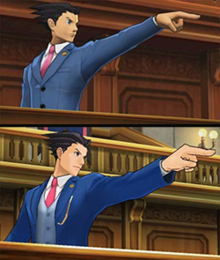
The developers focused on preserving the look of before games' 2D art: they created a concept model (meridian), and refined it until the entire team was satisfied (bottom).
Dual Destinies was the first game in the main series to exist developed for the Nintendo 3DS; this move from the Nintendo DS to the Nintendo 3DS was the most difficult part of the evolution, with the development team being unsure of whether to use 2d graphics similar with previous games or to apply 3D models. Eventually they decided to apply 3D graphics, considering of the stereoscopic 3D effect being a selling point for the Nintendo 3DS organization.[9] Because of the movement to 3D, the in-firm artist Takuro Fuse was in accuse of the art management,[9] [nineteen] rather than the series regular Tatsuro Iwamoto, so that they could accept meetings about the art more often. This was Fuse'due south get-go piece of work on the main serial, and so he initially had bug with making graphic symbol designs that fit the serial, and had to become a lot of feedback from Eshiro. Co-ordinate to Eshiro and Yamazaki, they put effort into the graphics, wanting to ensure that Dual Destinies ' graphics looked meliorate than those of Professor Layton vs. Phoenix Wright: Ace Attorney.[nine]
The get-go thing Fuse and his art team had to do was figuring out how to create 3D models that preserve the wait and feel of the previous games' 2D sprites, even when viewed in stereoscopic 3D. Some of the artists on the squad created a concept trailer for how the game's visuals would work, featuring a 3D model of Phoenix. Looking back at it, Fuse chosen the model "cringe-worthy", only it was able to be used as a base. Everyone on the development team gave feedback on the model, and it was continuously refined until everyone was satisfied with its look;[xix] this process alone took 6 months.[13] The art team also wanted to preserve the "lively" manner of blitheness used in the 2D sprites.[19] To do this, they used "various tricks" such equally using different character models for dissimilar angles.[13] They as well took advantage of the increased capabilities of the Nintendo 3DS hardware, and added camera movements and connecting animations to give the grapheme animation further fluidity.[xix]
Fuse found Athena difficult to blueprint, due to her beingness both an assistant to Phoenix and Apollo, and a potent-willed attorney who wants to show her capabilities in court. He designed her hairstyle based on how she would be continuing on the left of Phoenix or Apollo when assisting them, making certain that information technology looked good from that perspective. He also created the hairstyle to be able to convey Athena's enthusiasm and energy through its movements. He gave Athena the little gadget named Widget, that hangs around her cervix, to visually stand for the mood matrix. Every bit they wanted other characters to be able to see the mood matrix, it was decided to make Widget project the mood matrix as a hologram. The mood matrix itself, which needed to correspond people's mental land visually, was a claiming for the fine art squad. They somewhen decided to utilise the vastness of outer space and the Earth in the design, and ended upward using a portable planetarium as the base motif. This as well influenced the mood matrix background music, which Fuse described as having an "outer space feel".[xix]

Blackquill'due south blackness-and-white prison uniform reminded Fuse of the 47 Ronin, leading him to use Japanese clothing in the design.
When designing Simon Blackquill, the new rival prosecutor character, Fuse initially intended to brand him different from all previous Ace Chaser prosecutors and focusing almost entirely on the convict aspect of Blackquill, making him await similar a "full criminal". At this signal in development, Blackquill was intended to be the character who could clarify emotions based on voices, and then he was given a headgear to vesture. Next, Fuse put more than focus on the prosecutor attribute, simply concluded upward with a design that he described as "just another prosecutor"; he realized that the prosecutor and convict aspects were opposites, with one decreasing as the other increases.[19]
The blackness-and-white stripes on the prisoner's uniform in the first design reminded Fuse of the Forty-7 Ronin, who wore black and white; this led him to contain traditional Japanese clothing into the design. He chosen this the key to solving the problem, but still had further problems with the design: if he made the outfit too Japanese, Blackquill would non look like an Ace Attorney prosecutor, and he thought it would be strange if he gave him a katana like an actual ronin, since Blackquill is a captive, and fifty-fifty average citizens are not legally immune to carry swords. He realized that he could use a combination of Japanese black-and-white clothes and prosecutorial Western clothes constitute in the Meiji era, when Japan was Westernized. As they needed the character to look "sharp and stylish in Western vesture", the only direct indication of him being a convict in the end was his shackles. His messy ponytail was also used to convey a feeling of "long incarceration", as well as evoke the paradigm of a ronin. Blackquill's hawk, Taka, was initially simply meant as a part of the Japanese elements of the design, being reminiscent of Japanese falconers. Taka's part was eventually extended to bringing documents and show to Blackquill, highlighting how Blackquill'southward movements are hindered by his shackles. Fuse described the final blueprint equally looking like a "Meiji Restoration-era fighter".[19]
Cutscenes [edit]
Dual Destinies features animated cutscenes produced by the animation studio Bones,[20] which were directed by Seto at Capcom and Kenji Nagasaki at Bones. The scripts for these were drafted past Yamazaki, and included characters' lines as well as the full general events and backgrounds for each scene. After the scripts were written, they were sent to Nagasaki, who drew storyboards for the scenes. When boarding the sequences, he added suggestions for details and nuances; for case, in the script for ane scene, Athena was going to trip and fall over, while Nagasaki suggested and boarded her tumbling downward stairs, and added a guard character for her to interact with at the end of the scene to emphasize how painful the fall had been. Later on finalizing the scene, the team at Basic worked on the groundwork art; while the courtrooms and defendant lobbies are shown in-game, the courthouse's stairway and master hall had not been shown before, and had to be designed specifically for the cutscenes.[ten]
After the dissimilar components of a scene were finished, the squad at Bones created its layout art; this included things such as determining the photographic camera position throughout the scene and how movements would be done. The developers wanted to focus on how the characters' faces were fatigued and animated, and make sure that the characters matched their respective in-game 3D models, so Fuse gave detailed feedback on the layouts, and drew over them in red to signal what he wanted to exist changed. These changes included corrections to off-model drawings, facial expressions, torso postures, and graphic symbol acting. Once the layouts had been approved, the animators drew the fundamental animation, after which the in-between frames were drawn. Once the blithe footage was completed, information technology was put together and rendered in stereoscopic 3D. Voice acting, music, sound effects, sound leveling and remixing was then washed, and added to the cutscene.[ten]
Localization [edit]
Capcom announced a localization for the N American and European market in September 2012;[21] at the time, they had planned a localization for almost two years.[22] Capcom U.s.a.'s and then senior vice president, Christian Svensson, described the game's sales forecasts every bit high compared to the commercial performance of past Ace Chaser titles, which was necessary to get a Western release greenlit.[23]
The localization was directed past Janet Hsu, a series regular who previously worked on Ace Attorney equally the localization lead and lead translator. As the localization squad wanted to work closer with the developers on Dual Destinies than they had on previous games, the localization work was incorporated into the overall development of the game. This gave them a larger caste of insight into the developers' intentions with the game, helping them with localizing the game more than faithfully.[19] The localizers besides had more control over the pre-programmed dialogue scripts in Dual Destinies than they had in any of the previous Ace Attorney games: they were able to utilize an internally developed tool to transfer the scripts from the Japanese dialogue to the English i; the development staff would put the scripts in the general area they belonged in for each judgement, after which Hsu would suit the placement to increase the dramatic bear upon, for instance past having a dramatic break and finger-pointing blitheness occur at a specific word. Due to Japanese give-and-take order beingness unlike from English, Hsu sometimes had to add words to "push" a big reveal into the second half of the judgement or rearrange the society facts were revealed in, to make revelations line up with dramatic animations or photographic camera zooms.[xviii]
Hsu described the localization work as a balancing act, and said that continuity and consistency was very important. To avoid situations where a pocket-sized detail in i game is inverse in localization, and then comes back every bit a major signal in a sequel, Hsu avoided irresolute things unless necessary, such as when something in the original would not exist understood by the target audience. One thing the localization team had to go on in mind was keeping the writing in-character: when substituting a Japanese joke with an English i, they had to consider whether it would be something that the character would say, and not simply that it was funny. They as well worked towards having puns and references exist appropriate for the dialogue, so that the dialogue still makes sense to players who practice not get the reference or pun.[17]
Label and naming [edit]
I of the outset major decisions was how to localize grapheme names. Hsu said that if character names audio too foreign and do not have any unconscious associations fastened, rooted in the player'south culture and linguistic communication, they only come across as a "jumble of sounds" to the actor, serving no purpose; she felt that the localized names, like the originals, should strive to convey sure images and feelings to the role player. She said that this was particularly important in Ace Attorney, due to how integral each name is to its corresponding character. Hsu and the translators brainstormed ideas, and eliminated suggestions until they had a final proper noun for each grapheme. These names are puns or take meanings: Athena Cykes' beginning name is a continuation of the serial tradition of naming protagonists after mythological creatures or gods. The reason for spelling "Cykes" with a C instead of using the more than mutual spelling "Sykes" came from how "Sykes" was considered too similar to the previous character Ema Skye'south proper name, and how the shape of the letter C connects to the crescent moon motifs in the mood matrix, her glove and her earring. Widget was localized to use male pronouns because of his Japanese name, Monita ( モニ太 ), which uses the kanji character "ta" ( 太 ) from the proper name Tarou ( 太郎 ), and which is often used to create "generic-sounding picayune boy's proper name out of a noun". Widget's English language proper noun was chosen to audio picayune and cute, similarly to the Japanese version's apply of "ta" ( 太 ) rather than the usual way of writing "Monita" with the katakana grapheme "ta" ( タ ).[24]
While Simon Blackquill speaks in an onetime-fashioned and "rough" style in the Japanese version, matching what a ronin would be expected to audio like, Hsu said that this cultural shorthand of a ronin grapheme did not be in the W to build his character upon, so his label had to be rendered in a different manner to be more accessible to Western players. Hsu and the translators had the aforementioned trouble with this as Fuse had when balancing the prosecutor and convict aspects of the character, just eventually leaned more towards the prosecutor side, and made him speak Victorian English language. They felt that this made more sense than portraying him every bit a cursing delinquent due to his high intelligence, and his Victorian-era clothes, due to their different cultural connotations in the West compared to Japan.[24]
In the localization, they labeled him a samurai rather than a ronin – which is a subset of samurai – due to samurai being more than recognizable and readily understood for Western players. They still portrayed him every bit a "rude jerk", every bit they were able to preserve that aspect through word choice: Hsu said that both Japanese and English from the Victorian era could be verbose, making the 2 styles blend naturally during Blackquill'south "samurai" sword metaphors. Blackquill'south localized name was developed together with his fashion of spoken communication, and like with previous prosecutor characters, it was called to not be an "overt pun", but rather a name with a double meaning that describes him. His surname comes from how he wears a samurai boxing surcoat: these coats normally characteristic the wearer's family unit crest. The crest on Blackquill's coat features a blackness-and-white feather, then his proper name was based on the color ("black") and the feather ("quill"). Information technology was also fabricated in reference to the grapheme John Blackthorne from the novel Shōgun. The name was intended to sound like a "Victorian villain", to match his localized characterization and manner of voice communication.[24]
Visual changes and dubbing [edit]
Localizing backgrounds was more hard than information technology had been in previous games: while the earlier games used 2D illustrations as backgrounds, which could be inverse, Dual Destinies uses 3D models, hindering the localization squad from changing the shape of objects without risking encountering bugs. Considering of this, Hsu described some objects as not feeling right; the well-nigh prominent type of object affected by this was signs with vertical text, which she said did not experience as natural in English as in Japanese.[17] Some aspects of the user interface had to be modified every bit part of the localization: for example, some text had to be moved effectually on the relieve file screen because of some words existence longer in English than in Japanese, and a smaller font was chosen for the investigation notes to let for multiple lines of text. For the dialogue box, a thin condensed font was chosen, and the box itself was elongated, to make room for as much text equally in previous games. They just used two lines of text for it, both to look visually pleasing and to avoid hiding important detail backside a taller box.[vii]

Sam Riegel directed the dubbing, and voiced Phoenix.
For the cutscenes, the localization team took into account that the animation had been done to the Japanese lines, so they made certain that the English script matched the already set lip flaps and timing. Because the Japanese voice acting was not even so recorded when Hsu worked on the English dub script, she used her imagination to guess what the Japanese voice acting would be similar based on the script; this was made easier due to her familiarity with "standard anime conventions" from often watching anime. For some dialogue, she wrote alternative lines, as the footage had non yet been finished, and the script could be interpreted in unlike ways: in one scene, where Phoenix speaks on the telephone, Hsu had him follow the line "Information technology's for this very reason I returned" with either "Time to bring it to an end" or "To put an end to it all"; she used the former because of how there was a dramatic pause between the ii lines.[x]
The English language dub was recorded at Cup of Tea Productions, and was directed past Sam Riegel,[12] who also voiced Phoenix, having previously voiced the role in Ultimate Marvel vs. Capcom iii.[25] [26] Hsu was present for the recording, as she knew the story and was the translator of the scripts, and thus could explain what was happening in each scene and what the motivations behind the lines were, as well every bit how she wanted the phonation actors to deliver certain lines. Because Horiyama had attended the Japanese voice recording sessions, he was also nowadays, then he could requite communication about things that sounded too different from the Japanese version, and give consultation well-nigh technical issues within the game. The voice actors took turns recording their lines to most-last versions of the cutscenes, so they could match the characters' lip flaps. In improver to the voice acting, some sound effects had to be localized, due to sound being used differently in Japanese and Western films, resulting in different things sounding natural; one such case was the opening cutscene for the quaternary episode. Due to the English voice acting occasionally becoming unintelligible when sound effects or music was played on top, the localization team had to lower the volume of the music at some points, move the sound backwards or forwards slightly, or raise the volume of certain consonants; the largest such effect was the voice prune for the "Objection!" interjection, where the "b" consonant initially was drowned past the audio effect.[12]
Release [edit]
Dual Destinies was released for the Nintendo 3DS in Nihon on July 25, 2013,[27] and on October 24, 2013 in N America and Europe.[28] In Japan, a express edition was made available, which includes a Phoenix Wright figurine, a Nintendo 3DS pouch, and stickers.[29] The American and European releases were only made available digitally,[28] due to a lack of retail support for previous Ace Attorney games.[30] According to Eshiro, the developers besides wanted to reduce the delay between the Japanese and Western releases.[31] An iOS version was released on Baronial seven, 2014 in Japan and on August 14, 2014 in North America and Europe. The kickoff episode is bachelor for complimentary in this version, with remaining episodes being sold separately.[32] [33] An Android version was released in Japanese and English on May 23, 2017.[34] [35]
The two boosted episodes, Turnabout Reclaimed and Quiz Turnabout Deduction, were made available as downloadable content shortly subsequently the game'south Japanese release.[36] Turnabout Reclaimed was released in the West on November 21, 2013,[37] but Quiz Turnabout Deduction remained exclusive to Japan due to its dependency on in-depth noesis of Japanese culture.[38] Downloadable costumes for Phoenix, Athena and Apollo were made bachelor for download upon the game's release. These costumes were available for free until August 15, 2013 in Japan, and until Nov seven, 2013 for the English language versions, subsequently which they were available for purchase.[27] [39]
Reception [edit]
Dual Destinies received "generally favorable reviews", according to the review aggregator Metacritic.[40] It debuted at the top of the Japanese video game charts with 250,216 copies sold in its outset week.[48] According to Capcom, the projected sales of the game "were basically achieved".[49]
Chuck Osborn at IGN enjoyed searching crime scenes for clues, only wished that the mood matrix and perceive systems could have been used on need rather than at specific points merely.[46] Meanwhile, Reona Ebihara at Famitsu said that the mood matrix fits perfectly into the game and is fun to utilize.[43] Chris Hoffman at GamesRadar said that the gameplay felt fulfilling, with victories feeling earned, only that there were a few instances of "debatable" logic. He liked the mood matrix, saying that it adds "some nice multifariousness" to the trials. He also enjoyed the perceive and psyche-lock systems, simply found them underutilized.[45]
Aerox at Destructoid said that the game inherits issues from previous Ace Attorney games, such as how evidence sometimes can only exist presented when the game's script allows it, and how it sometimes is unclear how to trigger events during investigations; he did however notation that these occur less frequently than in previous Ace Attorney games.[42] Osborn criticized the cross-examinations, saying that objections that should logically be valid are sometimes non accepted by the game, and that the player often has to resort to trial and fault.[46] Meanwhile, Bryan Vore at Game Informer said that the in-game job list and new way of traveling made sure that he never felt lost during investigations, and knew what to practise to go along.[44] Urara Honma at Famitsu also noted the hints and lower difficulty every bit helpful features.[43]
Honma commented on the twist in the game's ending, calling it shocking, and saying that Dual Destinies was the best in the series. Rolling Uchizawa at Famitsu thought that some scenes during trials felt forced, simply that the back-and-forth dialog is effective at creating tension.[43] Aerox called the game "an extremely strong addition to the series", saying that the cohesiveness of the themes and narrative made the game's episodes more than connected than those in previous Ace Attorney games, and that he liked how the game discusses subjects such as declining trust in the legal organisation, the definition of justice, and people considering winning more important than the truth.[42] Vore said that the game'southward terminal two episodes had him "glued to the screen", but that he was tired of the series' reuse of the aforementioned story structure, with early cases having pocket-size connections to a bigger case, which in turn has a connection to a mystery from the past.[44]
Critics enjoyed the game'due south visuals:[42] [43] [44] [45] [46] Osborn said that it was the best-looking game in the serial, and that the 3D event worked well;[46] Ebihara described the animations as exciting to spotter and smoother than those in previous Ace Attorney games; and Honma said that the 3D characters felt more "live and charming" than the 2d characters in previous Ace Attorney games. Honma, Ebihara and Hoffman thought the character visuals retained their image and comical aspects from the 2D games,[43] [45] something Honma called "incredible".[43] Vore said that the new 3D environments made the crime scenes experience like existent places rather than "interactive paintings".[44] Aerox called the 3D animation beautiful, and liked the cutscenes and soundtrack.[42]
In addition, the English language localization was criticized for the affluence of typos and spelling mistakes.[l]
Accolades [edit]
The game was awarded 2013'south Best 3DS Adventure Game by IGN.[51] Gamezebo included information technology on a non-ranked list of the twenty-five all-time iOS games of 2014.[52] Digital Spy gave it a Game of the Year award for about memorable moment, for the game'south third episode, "Turnabout Academy", citing the narrative utilize of the friendship between the characters Juniper, Robin and Hugh.[53] It was also nominated for Destructoid'south "Best of 2013 Portable Game" award,[54] and was the runner-upwards for VGMO's award for the best Eastern soundtrack of 2013.[55] The downloadable episode Turnabout Reclaimed won Hardcore Gamer 's award for the best downloadable content of 2013.[56]
Notes [edit]
- ^ Known in Japan as Gyakuten Saiban 5 ( 逆転裁判 5 , lit. Turnabout Trial v)
References [edit]
- ^ a b Musgrave, Shaun (2014-08-15). "'Phoenix Wright: Ace Attorney - Dual Destinies' Review - No Objections To This Port's Quality". TouchArcade. Archived from the original on 2015-09-21. Retrieved 2016-05-20 .
- ^ Culafi, Alex (2013-ten-31). "Phoenix Wright: Ace Attorney - Dual Destinies". Nintendo World Report. Archived from the original on 2015-01-23. Retrieved 2016-06-02 .
- ^ a b c "Phoenix Wright: Ace Attorney - Dual Destinies Controls Manual" (PDF). Nintendo. Archived (PDF) from the original on 2016-04-06. Retrieved 2016-06-12 .
- ^ a b Corriea, Alexa Ray. "Phoenix Wright: Ace Attorney - Dual Destinies review: runaway jury". Polygon. Voice Media. Archived from the original on 2016-03-04.
- ^ Funk, John (2013-10-24). "Phoenix Wright: Dual Destinies launch trailer is an ace attorney tag-team". Polygon. Vox Media. Archived from the original on 2014-01-23. Retrieved 2016-06-27 .
- ^ Sato (2013-06-07). "A Closer Await At Apollo And Athena's Abilities In Ace Attorney: Dual Destinies". Siliconera. Archived from the original on 2015-09-25. Retrieved 2013-06-08 .
- ^ a b c d Hsu, Janet (2013-10-16). "Phoenix Wright: Ace Attorney – Dual Destinies Localization: The Trials and Tribulations of the Gameplay Mechanics Team". Capcom-Unity. Capcom. Archived from the original on 2016-04-eleven. Retrieved 2016-06-27 .
- ^ a b Gantayat, Anoop (2012-09-05). "Ace Attorney 5 Demo Set up For Tokyo Game Evidence". Andriasang. Archived from the original on 2016-06-24. Retrieved 2012-09-05 .
- ^ a b c d e f g "『逆転裁判』の話がしたい!!!". Nintendo Dream (in Japanese). Mainichi (262).
- ^ a b c d e Hsu, Janet (2013-10-24). "Intro to Japanese Anime Production starring Phoenix Wright". Capcom-Unity. Capcom. Archived from the original on 2015-08-22. Retrieved 2016-07-16 .
- ^ Klepek, Patrick (2007-05-22). "Capcom Confirms Ace Attorney v is Coming". 1UP.com. Ziff Davis. Archived from the original on 2016-07-15. Retrieved 2012-01-31 .
- ^ a b c d Hsu, Janet (2013-10-xxx). "Revitalizing the Sounds of Life: Behind the Audio of Ace Chaser". Capcom-Unity. Capcom. Archived from the original on 2015-08-22. Retrieved 2016-07-16 .
- ^ a b c d e f Ciolek, Todd (2013-07-31). "Dumbo Destiny - The X Button". Anime News Network. Archived from the original on 2015-09-10. Retrieved 2013-08-04 .
- ^ a b Jenkins, David (2013-07-03). "Phoenix Wright: Ace Chaser – Dual Destinies hands-on preview and interview – digital justice". Metro. DMG Media. Archived from the original on 2015-eleven-05. Retrieved 2016-07-xvi .
- ^ Hou, Laura (2012-x-21). "Ace Attorney 5′s Phoenix Wright Will Inherit His Traits From Apollo Justice: Ace Attorney". Siliconera. Archived from the original on 2016-04-xi. Retrieved 2012-10-22 .
- ^ a b c d e f Spencer (2013-07-24). "All Almost Making Ace Chaser: Dual Destinies With Producer Motohide Eshiro". Siliconera. Archived from the original on 2014-09-12. Retrieved 2015-09-27 .
- ^ a b c d e f Hsu, Janet (2013-10-09). "Phoenix Wright: Ace Attorney – Dual Destinies Localization: The Many Demands of an Ambitious Scenario Director". Capcom-Unity. Capcom. Archived from the original on 2016-03-09. Retrieved 2016-07-16 .
- ^ a b c Hsu, Janet (2013-12-04). "The Glorious Return of Phoenix to the Courtroom!". Capcom-Unity. Capcom. Archived from the original on 2015-08-22. Retrieved 2016-07-16 .
- ^ a b c d e f g h Hsu, Janet (2013-09-25). "Phoenix Wright: Ace Chaser - Dual Destinies Localization: Secrets of Character Design Revealed". Capcom-Unity. Capcom. Archived from the original on 2016-04-xi. Retrieved 2016-07-sixteen .
- ^ Khaw, Cassandra; Davison, Pete (2013-11-01). "How does Phoenix Wright: Ace Attorney - Dual Destinies Compare?". USgamer. Gamer Network. Archived from the original on 2016-03-05. Retrieved 2016-07-xvi .
- ^ George, Richard (2012-09-05). "Ace Attorney five Coming to Nintendo 3DS". IGN. Ziff Davis. Archived from the original on 2016-03-22. Retrieved 2012-09-05 .
- ^ Svensson, Christian (2012-09-06). "Ace Attorney v US?". Capcom-Unity. Capcom. p. 2. Archived from the original on 2016-03-04. Retrieved 2012-09-07 .
- ^ Ishaan (2012-09-17). "Ace Attorney five Sales Forecasts Are "Aggressive" Say Capcom United states". Siliconera. Archived from the original on 2016-04-xi. Retrieved 2012-09-18 .
- ^ a b c Hsu, Janet (2013-ten-01). "Phoenix Wright: Ace Attorney - Dual Destinies Localization: TRIVIA TIME!". Capcom-Unity. Capcom. Archived from the original on 2015-xi-30. Retrieved 2016-07-16 .
- ^ Smith, Carly (2013-ten-02). "Ace Chaser: Dual Destinies Trailer Features English Voices". The Escapist. Defy Media. Archived from the original on 2016-06-10. Retrieved 2016-07-xvi .
- ^ Riegel, Sam [@samriegel] (2011-10-13). "Just got word I tin officially announce I'm the voice of Phoenix Wright in UMvC3! youtu.exist/-LILhai7IHI OBJECTION!" (Tweet). Retrieved 2016-09-xiii – via Twitter.
- ^ a b Gifford, Kevin (2013-04-16). "Ace Chaser v Gets Release Date, Early-Purchase Bonuses, Goofy New Prosecutor". Polygon. Vox Media. Archived from the original on 2016-03-03. Retrieved 2013-04-17 .
- ^ a b Schreier, Jason (2013-05-xiii). "The Next Phoenix Wright Will Hit The West This Autumn [UPDATE]". Kotaku. Gawker Media. Archived from the original on 2016-06-10. Retrieved 2013-05-13 .
- ^ Sato (2013-04-17). "Ace Attorney 5 Limited Edition Comes With Phoenix Wright Effigy And More than". Siliconera. Archived from the original on 2015-01-23. Retrieved 2013-04-17 .
- ^ Matulef, Jeffrey (2013-05-fourteen). "Ace Attorney 5 will exist an eShop-only offering". Eurogamer. Gamer Network. Archived from the original on 2016-03-03. Retrieved 2013-05-16 .
- ^ Corriea, Alexa Ray (2013-06-12). "Ace Chaser — Dual Destinies is downloadable-only to reduce delay in English localized release". Polygon. Vox Media. Archived from the original on 2016-03-03. Retrieved 2013-06-12 .
- ^ "逆転裁判5". iTunes (in Japanese). Apple tree Inc. Archived from the original on 2016-03-06. Retrieved 2016-07-sixteen .
- ^ Mark (2014-08-14). "Phoenix Wright: Ace Attorney – Dual Destinies Priced For iOS [Update]". Siliconera. Archived from the original on 2016-04-13. Retrieved 2016-07-16 .
- ^ "Ace Chaser: Dual Destinies". Google Play. Archived from the original on 2017-05-24. Retrieved 2017-05-24 .
- ^ "逆転裁判5". Google Play. Archived from the original on 2017-05-25. Retrieved 2017-05-25 .
- ^ Gera, Emily (2013-07-25). "Ace Chaser: Dual Destinies asks you to defend a whale in courtroom in upcoming DLC". Polygon. Vox Media. Archived from the original on 2016-03-04. Retrieved 2013-08-04 .
- ^ "Ace Attorney on Twitter". Twitter. Archived from the original on 2016-03-05.
- ^ Antista, Chris (2013-07-25). "Phoenix Wright: Ace Attorney - Dual Destinies additional episode and Costume Pack confirmed for Western release". Capcom-Unity. Capcom. Archived from the original on 2016-06-eighteen. Retrieved 2013-08-04 .
- ^ Sato (2013-04-xvi). "Ace Attorney 5 Has A Prosecutor Who Is Accused Of Murder". Siliconera. Archived from the original on 2015-01-23. Retrieved 2013-04-17 .
- ^ a b "Phoenix Wright: Ace Attorney - Dual Destinies for 3DS Reviews". Metacritic. CBS Interactive. Archived from the original on 2016-03-05. Retrieved 2016-06-11 .
- ^ "Phoenix Wright: Ace Attorney - Dual Destinies for iPhone/iPad Reviews". Metacritic. CBS Interactive. Retrieved 2018-07-28 .
- ^ a b c d e Aerox (2013-10-24). "Review: Phoenix Wright: Ace Attorney - Dual Destinies". Destructoid. Modern Method. Archived from the original on 2016-03-29. Retrieved 2013-ten-25 .
- ^ a b c d e f m Gifford, Kevin (2013-07-17). "Japan Review Check: Ace Attorney 5, Dragon's Crown". Polygon. Vox Media. Archived from the original on 2014-04-02. Retrieved 2016-06-12 .
- ^ a b c d eastward Vore, Bryan (2013-10-21). "Phoenix Wright Fights To Stay Live In The Courtroom - Phoenix Wright: Ace Chaser – Dual Destinies - 3DS". Game Informer. GameStop. Archived from the original on 2016-03-03. Retrieved 2013-ten-25 .
- ^ a b c d Hoffman, Chris (2013-ten-24). "Phoenix Wright: Ace Attorney - Dual Destinies review". GamesRadar. Future plc. Archived from the original on 2016-04-09. Retrieved 2013-x-25 .
- ^ a b c d due east Osborn, Chuck (2013-10-24). "Phoenix Wright: Ace Attorney - Dual Destinies Review". IGN. Ziff Davis. Archived from the original on 2016-04-29. Retrieved 2016-06-11 .
- ^ Musgrave, Shaun (2014-08-15). "'Phoenix Wright: Ace Attorney – Dual Destinies' Review – No Objections To This Port's Quality". TouchhArcade . Retrieved 2018-07-28 .
- ^ "Nihon's Video Game Rankings, July 22–28 - Interest". Anime News Network. 2013-07-31. Archived from the original on 2013-09-06. Retrieved 2016-06-eleven .
- ^ Yin-Poole, Wesley (2014-05-08). "Expressionless Rising iii sales rise to i.2m equally Capcom enjoys turn a profit boost". Eurogamer. Gamer Network. Archived from the original on 2016-03-04. Retrieved 2016-06-11 .
- ^ McFerran, Damien (October 28, 2013). "Phoenix Wright: Dual Destinies Proves That Capcom Really Needs To Hire More Proofreaders". Nintendo Life.
- ^ "Best 3DS Adventure Game". IGN. Ziff Davis. Archived from the original on 2016-03-22. Retrieved 2016-06-11 .
- ^ Squires, Jim (2014-09-xix). "The 25 Best iPhone Games of 2014 (and then far)". Gamezebo. Archived from the original on 2015-10-31. Retrieved 2016-07-16 .
- ^ "Game of the Year 2013: Digital Spy picks the most memorable moments". Digital Spy. Hearst. 2013-12-28. Archived from the original on 2016-07-16. Retrieved 2016-07-16 .
- ^ Hansen, Steven (2013-12-sixteen). "Nominees for Destructoid's best of 2013 portable game". Destructoid. Mod Method. Archived from the original on 2015-09-16. Retrieved 2016-07-sixteen .
- ^ Greening, Chris (2014-04-twenty). "Annual Game Music Awards 2013 – Soundtracks of the Year". VGMO. Archived from the original on 2016-03-03. Retrieved 2016-07-xvi .
- ^ "2013 Best Downloadable Content". Hardcore Gamer. 2013-12-21. Archived from the original on 2016-03-13. Retrieved 2016-07-sixteen .
External links [edit]
- Official website
- Phoenix Wright: Ace Attorney – Dual Destinies at The Visual Novel Database
Source: https://en.wikipedia.org/wiki/Phoenix_Wright:_Ace_Attorney_%E2%80%93_Dual_Destinies
0 Response to "The Art of Phoenix Wright Ace Attorney Dual Destinies"
Post a Comment