How Can the Speed of Solvent Molecules Be Slowed Down?
Implicit solvation (sometimes termed continuum solvation) is a method to correspond solvent every bit a continuous medium instead of individual "explicit" solvent molecules, almost oftentimes used in molecular dynamics simulations and in other applications of molecular mechanics. The method is ofttimes applied to estimate free energy of solute-solvent interactions in structural and chemical processes, such as folding or conformational transitions of proteins, DNA, RNA, and polysaccharides, association of biological macromolecules with ligands, or transport of drugs across biological membranes.
The implicit solvation model is justified in liquids, where the potential of mean forcefulness can be applied to approximate the averaged beliefs of many highly dynamic solvent molecules. However, the interfaces and the interiors of biological membranes or proteins tin can besides be considered equally media with specific solvation or dielectric properties. These media are not necessarily uniform, since their properties can exist described by different analytical functions, such every bit "polarity profiles" of lipid bilayers.[1]
In that location are two basic types of implicit solvent methods: models based on accessible surface areas (ASA) that were historically the kickoff, and more recent continuum electrostatics models, although various modifications and combinations of the different methods are possible. The accessible surface expanse (ASA) method is based on experimental linear relations between Gibbs free energy of transfer and the surface area of a solute molecule.[2] This method operates directly with gratis energy of solvation, unlike molecular mechanics or electrostatic methods that include but the enthalpic component of free energy. The continuum representation of solvent also significantly improves the computational speed and reduces errors in statistical averaging that ascend from incomplete sampling of solvent conformations,[three] then that the free energy landscapes obtained with implicit and explicit solvent are different.[iv] Although the implicit solvent model is useful for simulations of biomolecules, this is an approximate method with certain limitations and problems related to parameterization and treatment of ionization effects.
Accessible surface area-based method [edit]
The free free energy of solvation of a solute molecule in the simplest ASA-based method is given by:
- Δ M s o l v = ∑ i σ i A S A i {\displaystyle \Delta G_{\mathrm {solv} }=\sum _{i}\sigma _{i}\ ASA_{i}}
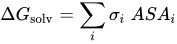
where A S A i {\displaystyle ASA_{i}} is the accessible surface area of atom i, and σ i {\displaystyle \sigma _{i}} is solvation parameter of atom i, i.e., a contribution to the gratis energy of solvation of the particular cantlet i per surface unit area. The needed solvation parameters for unlike types of atoms (carbon (C), nitrogen (N), oxygen (O), sulfur (S), etc.) are usually determined by a least squares fit of the calculated and experimental transfer free energies for a series of organic compounds. The experimental energies are adamant from partitioning coefficients of these compounds between different solutions or media using standard mole concentrations of the solutes.[five] [six]


Notably, solvation energy is the gratis energy needed to transfer a solute molecule from a solvent to vacuum (gas phase). This energy can supplement the intramolecular energy in vacuum calculated in molecular mechanics. Thus, the needed atomic solvation parameters were initially derived from water-gas partition data.[7] However, the dielectric backdrop of proteins and lipid bilayers are much more similar to those of nonpolar solvents than to vacuum. Newer parameters have thus been derived from octanol-h2o partition coefficients[8] or other similar data. Such parameters actually describe transfer energy between ii condensed media or the deviation of two solvation energies.
Poisson-Boltzmann [edit]
The Poisson-Boltzmann equation (PB) describes the electrostatic environment of a solute in a solvent containing ions. It can exist written in cgs units as:
- ∇ → ⋅ [ ϵ ( r → ) ∇ → Ψ ( r → ) ] = − iv π ρ f ( r → ) − 4 π ∑ i c i ∞ z i q λ ( r → ) east − z i q Ψ ( r → ) k T {\displaystyle {\vec {\nabla }}\cdot \left[\epsilon ({\vec {r}}){\vec {\nabla }}\Psi ({\vec {r}})\correct]=-4\pi \rho ^{f}({\vec {r}})-4\pi \sum _{i}c_{i}^{\infty }z_{i}q\lambda ({\vec {r}})e^{\frac {-z_{i}q\Psi ({\vec {r}})}{kT}}}
![{\vec {\nabla }}\cdot \left[\epsilon ({\vec {r}}){\vec {\nabla }}\Psi ({\vec {r}})\right]=-4\pi \rho ^{{f}}({\vec {r}})-4\pi \sum _{{i}}c_{{i}}^{{\infty }}z_{{i}}q\lambda ({\vec {r}})e^{{{\frac {-z_{{i}}q\Psi ({\vec {r}})}{kT}}}}](https://wikimedia.org/api/rest_v1/media/math/render/svg/7f592769c07a2a71afe4cd7d5b174416134f5195)
or (in mks):
- ∇ → ⋅ [ ϵ ( r → ) ∇ → Ψ ( r → ) ] = − ρ f ( r → ) − ∑ i c i ∞ z i q λ ( r → ) east − z i q Ψ ( r → ) chiliad T {\displaystyle {\vec {\nabla }}\cdot \left[\epsilon ({\vec {r}}){\vec {\nabla }}\Psi ({\vec {r}})\right]=-\rho ^{f}({\vec {r}})-\sum _{i}c_{i}^{\infty }z_{i}q\lambda ({\vec {r}})due east^{\frac {-z_{i}q\Psi ({\vec {r}})}{kT}}}
![{\vec {\nabla }}\cdot \left[\epsilon ({\vec {r}}){\vec {\nabla }}\Psi ({\vec {r}})\right]=-\rho ^{{f}}({\vec {r}})-\sum _{{i}}c_{{i}}^{{\infty }}z_{{i}}q\lambda ({\vec {r}})e^{{{\frac {-z_{{i}}q\Psi ({\vec {r}})}{kT}}}}](https://wikimedia.org/api/rest_v1/media/math/render/svg/fb44e996dde934e7946eeab56bb1c6b84f064cee)
where ϵ ( r → ) {\displaystyle \epsilon ({\vec {r}})} represents the position-dependent dielectric, Ψ ( r → ) {\displaystyle \Psi ({\vec {r}})} represents the electrostatic potential, ρ f ( r → ) {\displaystyle \rho ^{f}({\vec {r}})} represents the accuse density of the solute, c i ∞ {\displaystyle c_{i}^{\infty }} represents the concentration of the ion i at a distance of infinity from the solute, z i {\displaystyle z_{i}} is the valence of the ion, q is the accuse of a proton, one thousand is the Boltzmann constant, T is the temperature, and λ ( r → ) {\displaystyle \lambda ({\vec {r}})} is a gene for the position-dependent accessibility of position r to the ions in solution (frequently set to uniformly 1). If the potential is not big, the equation can be linearized to be solved more efficiently.[nine]


Although this equation has solid theoretical justification, information technology is computationally expensive to calculate without approximations. A number of numerical Poisson-Boltzmann equation solvers of varying generality and efficiency have been developed,[10] [11] [12] including one application with a specialized computer hardware platform.[13] Even so, performance from PB solvers does not notwithstanding equal that from the more than ordinarily used generalized Born approximation.[fourteen]
Generalized Born model [edit]
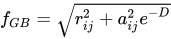
The Generalized Born (GB) model is an approximation to the exact (linearized) Poisson-Boltzmann equation. It is based on modeling the solute every bit a set of spheres whose internal dielectric constant differs from the external solvent. The model has the following functional form:
- G s = − 1 eight π ϵ 0 ( 1 − ane ϵ ) ∑ i , j N q i q j f G B {\displaystyle G_{s}=-{\frac {1}{viii\pi \epsilon _{0}}}\left(1-{\frac {1}{\epsilon }}\right)\sum _{i,j}^{N}{\frac {q_{i}q_{j}}{f_{GB}}}}

where
- f M B = r i j 2 + a i j two e − D {\displaystyle f_{GB}={\sqrt {r_{ij}^{ii}+a_{ij}^{2}e^{-D}}}}
and D = ( r i j ii a i j ) 2 , a i j = a i a j {\displaystyle D=\left({\frac {r_{ij}}{2a_{ij}}}\right)^{2},a_{ij}={\sqrt {a_{i}a_{j}}}}
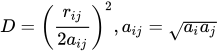
where ϵ 0 {\displaystyle \epsilon _{0}} is the permittivity of gratis space, ϵ {\displaystyle \epsilon } is the dielectric constant of the solvent being modeled, q i {\displaystyle q_{i}} is the electrostatic charge on particle i, r i j {\displaystyle r_{ij}} is the distance between particles i and j, and a i {\displaystyle a_{i}} is a quantity (with the dimension of length) termed the effective Born radius.[15] The effective Born radius of an atom characterizes its degree of burial within the solute; qualitatively information technology can be thought of equally the distance from the atom to the molecular surface. Accurate estimation of the constructive Born radii is critical for the GB model.[16]


With attainable surface expanse [edit]
The Generalized Born (GB) model augmented with the hydrophobic solvent accessible surface area (SA) term is GBSA. It is amongst the most ordinarily used implicit solvent model combinations. The apply of this model in the context of molecular mechanics is termed MM/GBSA. Although this formulation has been shown to successfully place the native states of short peptides with well-divers tertiary structure,[17] the conformational ensembles produced by GBSA models in other studies differ significantly from those produced by explicit solvent and do non place the poly peptide's native state.[iv] In item, salt bridges are overstabilized, possibly due to insufficient electrostatic screening, and a higher-than-native blastoff helix population was observed. Variants of the GB model have also been developed to gauge the electrostatic environment of membranes, which have had some success in folding the transmembrane helixes of integral membrane proteins.[xviii]
Advertizement hoc fast solvation models [edit]
Another possibility is to use ad hoc quick strategies to judge solvation free energy. A first generation of fast implicit solvents is based on the calculation of a per-atom solvent accessible surface area. For each of group of cantlet types, a different parameter scales its contribution to solvation ("ASA-based model" described above).[19]
Another strategy is implemented for the CHARMM19 force-field and is called EEF1.[20] EEF1 is based on a Gaussian-shaped solvent exclusion. The solvation costless free energy is
- Δ G i due south o l five = Δ Thou i r east f − ∑ j ∫ V j f i ( r ) d r {\displaystyle \Delta G_{i}^{solv}=\Delta G_{i}^{ref}-\sum _{j}\int _{Vj}f_{i}(r)dr}

The reference solvation free energy of i corresponds to a suitably chosen small molecule in which group i is essentially fully solvent-exposed. The integral is over the volume Vj of group j and the summation is over all groups j around i. EEF1 additionally uses a distance-dependent (non-constant) dielectric, and ionic side-chains of proteins are simply neutralized. It is simply l% slower than a vacuum simulation. This model was later augmented with the hydrophobic upshot and called Charmm19/SASA.[21]
Hybrid implicit-explicit solvation models [edit]
It is possible to include a layer or sphere of water molecules effectually the solute, and model the bulk with an implicit solvent. Such an approach is proposed by One thousand. J. Frisch and coworkers[22] and by other authors.[23] [24] For instance in Ref.[23] the bulk solvent is modeled with a Generalized Built-in approach and the multi-grid method used for Coulombic pairwise particle interactions. It is reported to be faster than a full explicit solvent simulation with the particle mesh Ewald summation (PME) method of electrostatic adding. There are a range of hybrid methods available capable of accessing and acquiring data on solvation.[25]
Effects unaccounted for [edit]
The hydrophobic issue [edit]
Models similar PB and GB allow estimation of the mean electrostatic free energy simply do non account for the (mostly) entropic furnishings arising from solute-imposed constraints on the system of the water or solvent molecules. This is termed the hydrophobic outcome and is a major cistron in the folding process of globular proteins with hydrophobic cores. Implicit solvation models may be augmented with a term that accounts for the hydrophobic outcome. The well-nigh pop style to practise this is by taking the solvent accessible area (SASA) every bit a proxy of the extent of the hydrophobic effect. Almost authors place the extent of this issue betwixt v and 45 cal/(Å2 mol).[26] Note that this surface surface area pertains to the solute, while the hydrophobic effect is more often than not entropic in nature at physiological temperatures and occurs on the side of the solvent.
Viscosity [edit]
Implicit solvent models such as Atomic number 82, GB, and SASA lack the viscosity that water molecules impart by randomly colliding and impeding the motion of solutes through their van der Waals repulsion. In many cases, this is desirable because it makes sampling of configurations and stage space much faster. This acceleration ways that more than configurations are visited per simulated time unit, on acme of whatever CPU acceleration is achieved in comparison to explicit solvent. It tin can, notwithstanding, atomic number 82 to misleading results when kinetics are of interest.
Viscosity may be added dorsum past using Langevin dynamics instead of Hamiltonian mechanics and choosing an advisable damping constant for the particular solvent.[27] In practical bimolecular simulations ane tin can ofttimes speed-up conformational search significantly (up to 100 times in some cases) past using much lower standoff frequency γ {\displaystyle \gamma } .[28] Recent work has likewise been done developing thermostats based on fluctuating hydrodynamics to account for momentum transfer through the solvent and related thermal fluctuations.[29] One should continue in mind, though, that the folding rate of proteins does not depend linearly on viscosity for all regimes.[30]

Hydrogen bonds with solvent [edit]
Solute-solvent hydrogen bonds in the offset solvation shell are of import for solubility of organic molecules and especially ions. Their boilerplate energetic contribution tin can exist reproduced with an implicit solvent model.[31] [32]
Bug and limitations [edit]
All implicit solvation models rest on the simple thought that nonpolar atoms of a solute tend to cluster together or occupy nonpolar media, whereas polar and charged groups of the solute tend to remain in water. Nevertheless, information technology is important to properly residuum the opposite energy contributions from different types of atoms. Several important points accept been discussed and investigated over the years.
Option of model solvent [edit]
Information technology has been noted that wet 1-octanol solution is a poor approximation of proteins or biological membranes because it contains ~2M of water, and that cyclohexane would be a much better approximation.[33] Investigation of passive permeability barriers for different compounds across lipid bilayers led to decision that one,ix-decadiene can serve equally a adept approximations of the bilayer interior,[34] whereas i-octanol was a very poor approximation.[35] A set up of solvation parameters derived for poly peptide interior from poly peptide engineering data was also different from octanol scale: it was close to cyclohexane scale for nonpolar atoms but intermediate between cyclohexane and octanol scales for polar atoms.[36] Thus, different atomic solvation parameters should be applied for modeling of protein folding and protein-membrane binding. This issue remains controversial. The original idea of the method was to derive all solvation parameters directly from experimental sectionalisation coefficients of organic molecules, which allows calculation of solvation costless energy. However, some of the recently developed electrostatic models utilise ad hoc values of 20 or 40 cal/(Åii mol) for all types of atoms. The non-existent "hydrophobic" interactions of polar atoms are overridden by big electrostatic free energy penalties in such models.
Solid-state applications [edit]
Strictly speaking, ASA-based models should only be practical to describe solvation, i.due east., energetics of transfer between liquid or uniform media. It is possible to express van der Waals interaction energies in the solid country in the surface energy units. This was sometimes done for interpreting poly peptide engineering and ligand binding energetics,[37] which leads to "solvation" parameter for aliphatic carbon of ~xl cal/(Å2 mol),[38] which is two times bigger than ~20 cal/(Å2 mol) obtained for transfer from water to liquid hydrocarbons, because the parameters derived by such fitting represent sum of the hydrophobic energy (i.due east., 20 cal/Å2 mol) and energy of van der Waals attractions of aliphatic groups in the solid state, which corresponds to fusion enthalpy of alkanes.[36] Unfortunately, the simplified ASA-based model cannot capture the "specific" distance-dependent interactions between different types of atoms in the solid land which are responsible for clustering of atoms with similar polarities in protein structures and molecular crystals. Parameters of such interatomic interactions, together with atomic solvation parameters for the protein interior, accept been approximately derived from protein engineering science data.[36] The implicit solvation model breaks down when solvent molecules acquaintance strongly with binding cavities in a protein, and so that the protein and the solvent molecules class a continuous solid trunk.[39] On the other hand, this model tin exist successfully applied for describing transfer from water to the fluid lipid bilayer.[40]
Importance of extensive testing [edit]
More testing is needed to evaluate the functioning of different implicit solvation models and parameter sets. They are oftentimes tested only for a small set of molecules with very simple structure, such equally hydrophobic and amphiphilic alpha helixes (α). This method was rarely tested for hundreds of protein structures.[forty]
Handling of ionization effects [edit]
Ionization of charged groups has been neglected in continuum electrostatic models of implicit solvation, likewise as in standard molecular mechanics and molecular dynamics. The transfer of an ion from water to a nonpolar medium with dielectric constant of ~3 (lipid bilayer) or 4 to x (interior of proteins) costs meaning free energy, as follows from the Born equation and from experiments. However, since the charged protein residues are ionizable, they simply lose their charges in the nonpolar environs, which costs relatively lilliputian at the neutral pH: ~4 to 7 kcal/mol for Asp, Glu, Lys, and Arg amino acrid residues, according to the Henderson-Hasselbalch equation, ΔG = 2.3RT (pH - pK). The low energetic costs of such ionization effects have indeed been observed for poly peptide mutants with buried ionizable residues.[41] and hydrophobic α-helical peptides in membranes with a unmarried ionizable residue in the middle.[42] However, all electrostatic methods, such every bit PB, GB, or GBSA assume that ionizable groups remain charged in the nonpolar environments, which leads to grossly overestimated electrostatic free energy. In the simplest accessible surface area-based models, this problem was treated using different solvation parameters for charged atoms or Henderson-Hasselbalch equation with some modifications.[40] However even the latter arroyo does not solve the trouble. Charged residues can remain charged fifty-fifty in the nonpolar environment if they are involved in intramolecular ion pairs and H-bonds. Thus, the energetic penalties can exist overestimated even using the Henderson-Hasselbalch equation. More rigorous theoretical methods describing such ionization effects accept been developed,[43] and there are ongoing efforts to comprise such methods into the implicit solvation models.[44]
Encounter also [edit]
- Polarizable continuum model
- COSMO solvation model
- Molecular dynamics
- Molecular mechanics
- H2o model
- Forcefulness field (chemical science)
- Comparing of strength field implementations
- Poisson'due south equation
- Attainable surface expanse
- Comparison of software for molecular mechanics modeling
- Solvent models
References [edit]
- ^ Marsh D (Jul 2001). "Polarity and permeation profiles in lipid membranes". Proceedings of the National Academy of Sciences of the U.s.a.. 98 (fourteen): 7777–82. Bibcode:2001PNAS...98.7777M. doi:10.1073/pnas.131023798. PMC35418. PMID 11438731.
- ^ Richards FM (1977). "Areas, volumes, packing and protein structure". Annual Review of Biophysics and Bioengineering. 6: 151–76. doi:10.1146/annurev.bb.06.060177.001055. PMID 326146.
- ^ Roux B, Simonson T (Apr 1999). "Implicit solvent models". Biophysical Chemistry. 78 (ane–2): ane–twenty. doi:10.1016/S0301-4622(98)00226-9. PMID 17030302.
- ^ a b Zhou R (Nov 2003). "Energy landscape of protein folding in water: explicit vs. implicit solvent". Proteins. 53 (2): 148–61. doi:10.1002/prot.10483. PMID 14517967. S2CID 22977210.
- ^ Ben-Naim AY (1980). Hydrophobic interactions. New York: Plenum Press. ISBN978-0-306-40222-seven.
- ^ Holtzer A (Jun 1995). "The "cratic correction" and related fallacies" (Complimentary total text). Biopolymers. 35 (6): 595–602. doi:10.1002/bip.360350605. PMID 7766825. S2CID 45118648.
- ^ Ooi T, Oobatake Thousand, Némethy G, Scheraga HA (May 1987). "Accessible surface areas as a measure of the thermodynamic parameters of hydration of peptides" (Free total text). Proceedings of the National Academy of Sciences of the United States of America. 84 (10): 3086–90. Bibcode:1987PNAS...84.3086O. doi:10.1073/pnas.84.ten.3086. PMC304812. PMID 3472198.
- ^ Eisenberg D, McLachlan AD (January 1986). "Solvation energy in poly peptide folding and binding". Nature. 319 (6050): 199–203. Bibcode:1986Natur.319..199E. doi:10.1038/319199a0. PMID 3945310. S2CID 21867582.
- ^ Fogolari F, Brigo A, Molinari H (Nov 2002). "The Poisson-Boltzmann equation for biomolecular electrostatics: a tool for structural biology". Journal of Molecular Recognition. 15 (6): 377–92. doi:ten.1002/jmr.577. PMID 12501158. S2CID 17184352.
- ^ Shestakov AI, Milovich JL, Noy A (Mar 2002). "Solution of the nonlinear Poisson-Boltzmann equation using pseudo-transient continuation and the finite element method". Journal of Colloid and Interface Science. 247 (one): 62–79. Bibcode:2002JCIS..247...62S. doi:ten.1006/jcis.2001.8033. PMID 16290441.
- ^ Lu B, Zhang D, McCammon JA (Jun 2005). "Computation of electrostatic forces between solvated molecules adamant by the Poisson-Boltzmann equation using a boundary element method" (PDF). The Journal of Chemical Physics. 122 (21): 214102. Bibcode:2005JChPh.122u4102L. doi:ten.1063/1.1924448. PMID 15974723.
- ^ Baker NA, Sept D, Joseph Southward, Holst MJ, McCammon JA (Aug 2001). "Electrostatics of nanosystems: application to microtubules and the ribosome". Proceedings of the National Academy of Sciences of the Us. 98 (18): 10037–41. Bibcode:2001PNAS...9810037B. doi:x.1073/pnas.181342398. PMC56910. PMID 11517324.
- ^ Höfinger Due south (Aug 2005). "Solving the Poisson-Boltzmann equation with the specialized reckoner chip MD-GRAPE-2". Journal of Computational Chemistry. 26 (11): 1148–54. doi:10.1002/jcc.20250. PMID 15942918. S2CID 19378083.
- ^ Koehl P (April 2006). "Electrostatics calculations: latest methodological advances". Current Opinion in Structural Biological science. 16 (2): 142–51. doi:ten.1016/j.sbi.2006.03.001. PMID 16540310.
- ^ Notwithstanding WC, Tempczyk A, Hawley RC, Hendrickson T (1990). "Semianalytical treatment of solvation for molecular mechanics and dynamics". J Am Chem Soc. 112 (sixteen): 6127–6129. doi:ten.1021/ja00172a038.
- ^ Onufriev A, Case DA, Bashford D (November 2002). "Effective Born radii in the generalized Built-in approximation: the importance of being perfect". Journal of Computational Chemical science. 23 (14): 1297–304. CiteSeerX10.1.1.107.962. doi:x.1002/jcc.10126. PMID 12214312. S2CID 12244353.
- ^ Ho BK, Dill KA (Apr 2006). "Folding very short peptides using molecular dynamics". PLOS Computational Biology. ii (iv): e27. Bibcode:2006PLSCB...two...27H. doi:ten.1371/journal.pcbi.0020027. PMC1435986. PMID 16617376.
- ^ Im West, Feig Thou, Brooks CL (Nov 2003). "An implicit membrane generalized born theory for the study of structure, stability, and interactions of membrane proteins". Biophysical Journal. 85 (five): 2900–eighteen. Bibcode:2003BpJ....85.2900I. doi:10.1016/S0006-3495(03)74712-2. PMC1303570. PMID 14581194.
- ^ Wesson Fifty, Eisenberg D (Feb 1992). "Diminutive solvation parameters applied to molecular dynamics of proteins in solution" (Free full text). Protein Science. i (2): 227–35. doi:ten.1002/pro.5560010204. PMC2142195. PMID 1304905.
- ^ Lazaridis T, Karplus M (May 1999). "Effective free energy part for proteins in solution". Proteins. 35 (2): 133–52. doi:10.1002/(SICI)1097-0134(19990501)35:2<133::AID-PROT1>3.0.CO;two-N. PMID 10223287.
- ^ Ferrara P, Apostolakis J, Caflisch A (January 2002). "Evaluation of a fast implicit solvent model for molecular dynamics simulations". Proteins. 46 (1): 24–33. CiteSeerXx.one.ane.25.1195. doi:x.1002/prot.10001. PMID 11746700. S2CID 17671699.
- ^ TA Keith, MJ Frisch (1994). "Chapter 3: Inclusion of Explicit Solvent Molecules in a Self-Consistent-Reaction Field Model of Solvation". In Smith D (ed.). Modeling the hydrogen bond . Columbus, OH: American Chemical Society. ISBN978-0-8412-2981-v.
- ^ a b Lee MS, Salsbury FR, Olson MA (Dec 2004). "An efficient hybrid explicit/implicit solvent method for biomolecular simulations". Journal of Computational Chemistry. 25 (16): 1967–78. doi:10.1002/jcc.20119. PMID 15470756. S2CID 16996683.
- ^ Marini A, Muñoz-Losa A, Biancardi A, Mennucci B (Dec 2010). "What is solvatochromism?". The Periodical of Physical Chemistry B. 114 (51): 17128–35. doi:10.1021/jp1097487. PMID 21128657.
- ^ Skyner RE, McDonagh JL, Groom CR, van Mourik T, Mitchell JB (Mar 2015). "A review of methods for the adding of solution costless energies and the modelling of systems in solution". Physical Chemical science Chemical Physics. 17 (9): 6174–91. Bibcode:2015PCCP...17.6174S. doi:ten.1039/C5CP00288E. PMID 25660403.
- ^ Sharp KA, Nicholls A, Fine RF, Honig B (Apr 1991). "Reconciling the magnitude of the microscopic and macroscopic hydrophobic effects". Science. 252 (5002): 106–9. Bibcode:1991Sci...252..106S. doi:10.1126/science.2011744. PMID 2011744.
- ^ Schlick T (2002). Molecular Modeling and Simulation: An Interdisciplinary Guide Interdisciplinary Applied Mathematics: Mathematical Biology. New York: Springer. ISBN978-0-387-95404-2.
- ^ Anandakrishnan R, Drozdetski A, Walker RC, Onufriev AV (March 2015). "Speed of conformational change: comparison explicit and implicit solvent molecular dynamics simulations". Biophysical Journal. 108 (5): 1153–64. Bibcode:2015BpJ...108.1153A. doi:10.1016/j.bpj.2014.12.047. PMC4375717. PMID 25762327.
- ^ Wang Y, Sigurdsson JK, Brandt E, Atzberger PJ (August 2013). "Dynamic implicit-solvent coarse-grained models of lipid bilayer membranes: fluctuating hydrodynamics thermostat". Physical Review E. 88 (2): 023301. arXiv:1212.0449. Bibcode:2013PhRvE..88b3301W. doi:10.1103/PhysRevE.88.023301. PMID 24032960. S2CID 118409341.
- ^ Zagrovic B, Pande 5 (September 2003). "Solvent viscosity dependence of the folding rate of a minor protein: distributed calculating study". Journal of Computational Chemical science. 24 (12): 1432–6. doi:10.1002/jcc.10297. PMID 12868108. S2CID 16666252.
- ^ Lomize AL, Pogozheva ID, Mosberg Hello (Apr 2011). "Anisotropic solvent model of the lipid bilayer. one. Parameterization of long-range electrostatics and starting time solvation shell effects". Journal of Chemical Information and Modeling. 51 (4): 918–29. doi:10.1021/ci2000192. PMC3089899. PMID 21438609.
- ^ Lomize AL, Pogozheva ID, Mosberg HI (Apr 2011). "Anisotropic solvent model of the lipid bilayer. 2. Energetics of insertion of minor molecules, peptides, and proteins in membranes". Journal of Chemical Information and Modeling. 51 (four): 930–46. doi:ten.1021/ci200020k. PMC3091260. PMID 21438606.
- ^ Radzicka A, Wolfenden R (1988). "Comparing the polarities of the amino acids: side-concatenation distribution coefficients between the vapor stage, cyclohexane, one-octanol, and neutral aqueous solution". Biochemistry. 27 (five): 1664–1670. doi:x.1021/bi00405a042.
- ^ Mayer PT, Anderson BD (Mar 2002). "Transport across i,9-decadiene precisely mimics the chemical selectivity of the barrier domain in egg lecithin bilayers". Journal of Pharmaceutical Sciences. 91 (3): 640–6. doi:ten.1002/jps.10067. PMID 11920749.
- ^ Walter A, Gutknecht J (1986). "Permeability of pocket-size nonelectrolytes through lipid bilayer membranes". The Journal of Membrane Biological science. 90 (iii): 207–17. doi:10.1007/BF01870127. PMID 3735402. S2CID 23972379.
- ^ a b c Lomize AL, Reibarkh MY, Pogozheva ID (Aug 2002). "Interatomic potentials and solvation parameters from protein engineering data for cached residues" (Gratuitous full text). Poly peptide Scientific discipline. eleven (8): 1984–2000. doi:10.1110/ps.0307002. PMC2373680. PMID 12142453.
- ^ Eriksson AE, Baase WA, Zhang XJ, Heinz DW, Blaber G, Baldwin EP, Matthews BW (Jan 1992). "Response of a poly peptide structure to cavity-creating mutations and its relation to the hydrophobic effect". Science. 255 (5041): 178–83. Bibcode:1992Sci...255..178E. CiteSeerXx.1.i.461.7843. doi:10.1126/scientific discipline.1553543. PMID 1553543.
- ^ Funahashi J, Takano Thousand, Yutani K (Feb 2001). "Are the parameters of various stabilization factors estimated from mutant human lysozymes compatible with other proteins?" (Free full text). Protein Engineering. fourteen (2): 127–34. doi:10.1093/protein/14.2.127. PMID 11297670.
- ^ Lomize AL, Pogozheva ID, Mosberg HI (Oct 2004). "Quantification of helix-helix binding affinities in micelles and lipid bilayers" (Gratis full text). Protein Science. 13 (10): 2600–12. doi:ten.1110/ps.04850804. PMC2286553. PMID 15340167.
- ^ a b c Lomize AL, Pogozheva ID, Lomize MA, Mosberg HI (Jun 2006). "Positioning of proteins in membranes: a computational approach" (Free full text). Protein Science. xv (6): 1318–33. doi:x.1110/ps.062126106. PMC2242528. PMID 16731967.
- ^ Dao-pin Southward, Anderson DE, Baase WA, Dahlquist FW, Matthews BW (Dec 1991). "Structural and thermodynamic consequences of burying a charged residue within the hydrophobic core of T4 lysozyme". Biochemistry. xxx (49): 11521–9. doi:ten.1021/bi00113a006. PMID 1747370.
- ^ Caputo GA, London Eastward (Mar 2003). "Cumulative effects of amino acid substitutions and hydrophobic mismatch upon the transmembrane stability and conformation of hydrophobic blastoff-helices". Biochemistry. 42 (11): 3275–85. doi:10.1021/bi026697d. PMID 12641459.
- ^ Schaefer M, van Vlijmen HW, Karplus G (1998). "Electrostatic contributions to molecular free energies in solution". Linkage Thermodynamics of Macromolecular Interactions. Advances in Protein Chemistry. Vol. 51. pp. i–57. doi:ten.1016/S0065-3233(08)60650-6. ISBN978-0-12-034251-8. PMID 9615168.
- ^ García-Moreno EB, Fitch CA (2004). "Structural interpretation of pH and salt-dependent processes in proteins with computational methods". Energetics of Biological Macromolecules, Function E. Methods in Enzymology. Vol. 380. pp. twenty–51. doi:10.1016/S0076-6879(04)80002-eight. ISBN978-0-12-182784-vii. PMID 15051331.
0 Response to "How Can the Speed of Solvent Molecules Be Slowed Down?"
Post a Comment