If You Have Kidney Stones Once Are You Likely to Get Them Again
In this department:
- What are kidney stones?
- Exercise kidney stones have another name?
- What type of kidney stones exercise I take?
- How mutual are kidney stones?
- Who is more than probable to develop kidney stones?
- What are the complications of kidney stones?
What are kidney stones?
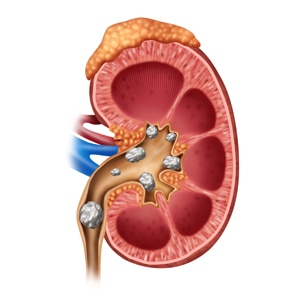
Kidney stones are hard, pebble-like pieces of material that form in ane or both of your kidneys when high levels of certain minerals are in your urine. Kidney stones rarely cause permanent impairment if treated by a wellness care professional person.
Kidney stones vary in size and shape. They may be equally small as a grain of sand or as big as a pea. Rarely, some kidney stones are as big every bit golf assurance. Kidney stones may be smooth or jagged and are usually yellow or brown.
A small kidney stone may laissez passer through your urinary tract on its ain, causing little or no pain. A larger kidney stone may get stuck along the fashion. A kidney stone that gets stuck tin cake your flow of urine, causing severe pain or bleeding. Learn more almost your urinary tract and how it works.
If you have symptoms of kidney stones, including severe hurting or haemorrhage, seek intendance right away. A doctor, such as a urologist, can care for any hurting and prevent further problems, such as a urinary tract infection (UTI).
Do kidney stones have another name?
The scientific name for a kidney stone is renal calculus or nephrolith. You may hear wellness care professionals telephone call this condition nephrolithiasis, urolithiasis, or urinary stones.
What type of kidney stones do I have?
You probably have ane of four main types of kidney stones. Treatment for kidney stones usually depends on their size, location, and what they are fabricated of.
Calcium stones
Calcium stones, including calcium oxalate stones and calcium phosphate stones, are the about common types of kidney stones. Calcium oxalate stones are more than common than calcium phosphate stones.
Calcium from nutrient does non increase your chance of having calcium oxalate stones. Normally, extra calcium that isn't used by your bones and muscles goes to your kidneys and is flushed out with urine. When this doesn't happen, the calcium stays in the kidneys and joins with other waste matter products to form a kidney stone.
Uric acid stones
A uric acid stone may grade when your urine contains as well much acid. Eating a lot of fish, shellfish, and meat—specially organ meat—may increase uric acid in urine.
Struvite stones
Struvite stones may grade after you take a UTI. They can develop suddenly and become large rapidly.
Cystine stones
Cystine stones effect from a disorder called cystinuria that is passed down through families. Cystinuria causes the amino acid cystine to leak through your kidneys and into the urine.
How mutual are kidney stones?
Kidney stones are mutual and are on the rise. About 11 percent of men and 6 per centum of women in the United States have kidney stones at to the lowest degree once during their lifetime.1
Who is more likely to develop kidney stones?
Men are more than likely to develop kidney stones than women. If you take a family history of kidney stones, you are more probable to develop them. You are also more probable to develop kidney stones over again if you lot've had them once.
You may besides be more than likely to develop a kidney stone if you lot don't drink plenty liquids.
People with certain conditions
You lot are more likely to develop kidney stones if you accept certain conditions, including
- a blockage of the urinary tract
- chronic, or long-lasting, inflammation of the bowel
- cystic kidney diseases, which are disorders that cause fluid-filled sacs to form on the kidneys
- cystinuria
- digestive problems or a history of alimentary canal surgery
- gout, a disorder that causes painful swelling of the joints
- hypercalciuria, a status that runs in families in which urine contains unusually large amounts of calcium; this is the most common condition found in people who class calcium stones
- hyperoxaluria, a status in which urine contains unusually large amounts of oxalate
- hyperparathyroidism, a condition in which the parathyroid glands release besides much parathyroid hormone, causing extra calcium in the claret
- hyperuricosuria, a disorder in which besides much uric acid is in the urine
- obesity
- repeated, or recurrent, UTIs
- renal tubular acidosis, a affliction that occurs when the kidneys fail to remove acids into the urine, which causes a person's blood to remain too acidic
People who have certain medicines
You are more likely to develop kidney stones if you are taking one or more of the following medicines over a long period of time:
- diuretics, frequently called water pills, which assistance rid your trunk of water
- calcium-based antacids
- indinavir, a protease inhibitor used to treat HIV infection
- topiramate, an anti-seizure medication
What are the complications of kidney stones?
Complications of kidney stones are rare if you seek treatment from a health care professional person earlier bug occur.
If kidney stones are not treated, they can cause
- hematuria, or claret in the urine
- astringent pain
- UTIs, including kidney infections
- loss of kidney function
References
Source: https://www.niddk.nih.gov/health-information/urologic-diseases/kidney-stones/definition-facts
0 Response to "If You Have Kidney Stones Once Are You Likely to Get Them Again"
Post a Comment